
"We Let the Data Do the Work": How a New Generation Is Seeking To Rewire Geopolitical Forecasting
Why Downstream Intelligence Thinks Geopolitics Needs a New Operating System

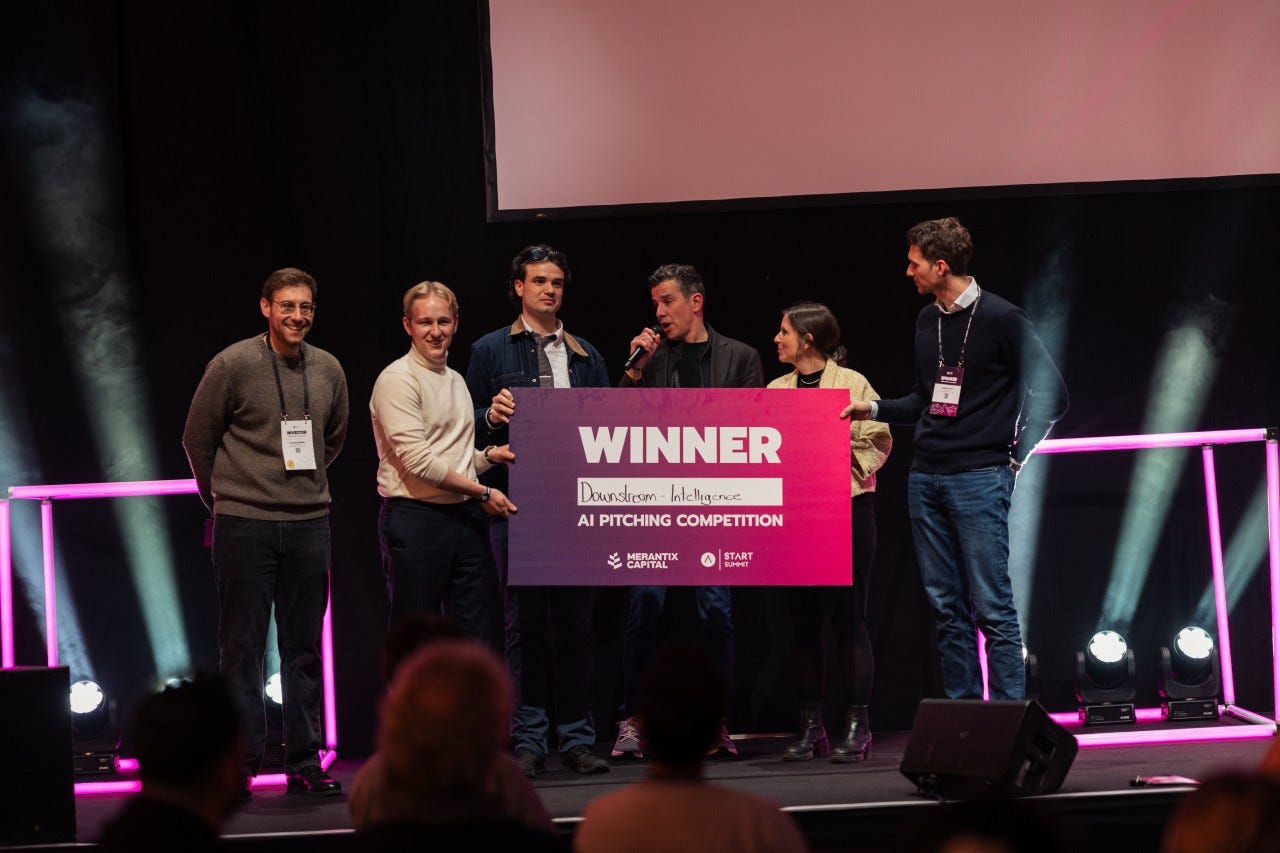
Origin & Team Behind Downstream Intelligence
Downstream Intelligence—founded by a group of Fletcher School graduates—describes itself as “an AI/M[achine]L[earning]‑native geopolitical scenario forecaster,” aiming to make sense of world events at the speed they unfold.
But the company is also part of a generational shift. Its founders belong to a cohort of analysts shaped not by think‑tank habits, but by prediction markets and probabilistic reasoning.
They see geopolitics as something to model, test, and update in public — not a privately circulated memo.
The team behind Downstream Intelligence blends backgrounds in policy, technical, and communication. Sandy Glickman previously worked in the IMF Managing Director’s office. Rachel Leighton trained in mathematics at MIT and studied East Asian technology and international affairs at the Fletcher School, focusing on computation and East Asian tech policy. Raffael Hüberli brings experience from Swissnex in San Francisco, the Swiss Army press office, and earlier work as a journalist.
“With Rachel”, notes Raffa, “we have someone who is extremely strong in computer science and mathematics, which helps us to turn the qualitative insights from news articles etc. into quantitative data points that we can then use to build our model. Her…current research [that] she’s conducting as part of her PhD in Mathematics at MIT directly relates to what we’re building.”
A Computational Way of Seeing the World
Downstream Intelligence’s first product, Augury 1.0, is a model and “terminal‑style platform” designed to forecast what comes next. At its core is a structured way of breaking down events into signals, drivers, and causal chains. Signals are observable data points, drivers are the forces behind them, and causal chains show how one event leads to another.
Instead of relying on country experts writing narrative assessments, Downstream Intelligence treats global politics as a system of interacting variables that can be decomposed, modelled, and recombined. It mirrors how prediction‑market participants think:
Break the problem down.
Assign probabilities.
Update continuously.
“We let the data do the work here”, adds Sandy. “We bound our scenarios by an upside, a downside, and a base. Each scenario has exclusive measurable requirements in order to identify closest outcomes.”
Pressed on the fundamental limits of forecasting, Rachel explains:
“There are so many absolute limits to forecasting - even with AI-native tools. We can’t map the entirety of the world and smaller events that may go unreported have ripple effects onto larger events. Forecasting is non-deterministic, so it’s impossible to get completely right even with the most cutting edge technology and mathematics.”
“I am bullish that what were once considered Black Swan events, such as COVID-19 or the 2008 financial crisis will be better anticipated and (hopefully) more proactive decisions will be taken. However, this is less about AI forecasting and more about AI helping to understand new realities without one’s cognitive bias preventing them from doing so.”
Forecasting in Public
Credibility is the company’s biggest challenge.
Downstream Intelligence does not hide its scorecard in the footnotes of an obscure quarterly report. They’ve built a fast‑growing Instagram presence (@downstreamintel), now with nearly 29,000 followers.
Each video features Sandy at a desk, in a suit and tie, typing on a typewriter. “Will the US strike Cuba by Jan 31?” he asks in one video. “Will North Korea launch a missile before Feb 28?” he asks in another.
The look is deliberate - it turns forecasting into a public act, where probabilities are posted, tracked, and judged in real time, making it the opposite of the private, cautious style of traditional risk analysis. Downstream Intelligence’s videos normalise being wrong so long as the model updates accordingly — a core value of the prediction‑market generation. “The typing and slide noises are good call to attention hooks - it’s simple and repeatable”, Sandy explains.
“We are really excited about how AI can be leveraged on the backend, but on the frontend we want to be as human as possible...By recentering this around us as humans testing a system we are openly and actively testing, it allows us to fully own our losses without ego, tinker with the model, and improve while building a community invested in the process.”
Raffa makes the case that “our public-facing work serves as more than just a tool to get the word out. It is also important for us to build a community around what we’re trying to do and feel the momentum of the people that are interested in what we’re developing.”
In a podcast interview in January, Sandy reflected that, “Rachel and I are not the best at explaining what we do.” Yet the videos do exactly that: they make forecasting visible.
“There’s an exhausting trend in the startup community to describe yourself as a “builder” or a “founder””, Sandy told me. “Everyone is trying to signal that they know exactly what the future looks like and they are “just shipping it”....we describe ourselves as tinkerers; taking complex systems apart, probing what’s working, and fixing what we can.”
The Market Challenge
According to Raffa, “the way out there vision is to also be in the toolkit for analysts” and compete with the biggest players like Eurasia Group. Yet, the geopolitical‑risk market is slow to buy and dominated by well‑funded incumbents such as Recorded Future, Control Risks, and Blackbird.AI, as well as hyperscalers (large technology companies that provide enormous cloud computing capacity) increasingly embedding risk‑intelligence features into enterprise platforms.
But the deeper challenge is cultural. Clients are still shaped by the think‑tank mindset that favours authoritative narratives over probability ranges, clear explanations over model-native reasoning, polished memos over causal-chain graphs, and industry incumbents because they speak their language.
Downstream Intelligence must show that its scenario‑generation engine offers something meaningfully better than generic LLM outputs, free OSINT dashboards, or established intelligence platforms.
That’s difficult when sales cycles stretch 6–18 months and clients demand transparency, liability‑safe outputs, and a clear sense of how the model thinks.
Add in regulatory pressure around AI safety, political content, and explainability, and the company must scale its technology, revenue, and governance faster than most early‑stage teams can manage.
On these challenges, Sandy acknowledges that:
“Political risk consultancies act as incredible nodes in an intelligence network between government officials, corporations, NGOs, security experts, and the media. Their ability to easily call on all of those experts and leverage those relationships is an unfair advantage that cannot be replaced by AI…At the same time, they will absolutely have to adapt to automated processes in the intelligence collecting, analyzing, and reporting cycles just to maintain their edge over cheaper, AI-native platforms.”
“We recognized very early on that if we went down the traditional consulting or advising route, we would have to fundamentally change how we think about transparency and experimentation….The amount of startups in this space selling information and predictive intelligence is baffling to me. If your model is truly better than everyone else’s, why are you selling your edge?”
A Generational Bet
Downstream Intelligence’s wager is ultimately about industry culture, not code.
Its founders are betting that a new analytical style—probabilistic, iterative, computational, and public—will displace the think‑tank habits that have shaped geopolitical work for decades.
If that shift takes hold, their approach looks prescient: a model that updates in real time, a community that expects transparency, and a team comfortable being wrong in public because the point is to learn faster than the world changes.
But if the old mindset endures, then Downstream Intelligence faces a steeper climb. The incumbents will keep their advantage not because their tools are better, but because their style still matches what enterprise buyers recognise as “analysis.”
Should the next generation embrace continuous updating over confident assertion, Downstream Intelligence will seem less like an outlier and more like a prototype. If they don’t, the incumbents will keep winning — not because they see the world more clearly, but because they still speak the language of certainty. Either way, the experiment is already underway.
About the Author
Dr. Tom Parkin is a consultant and analyst focused on conflict communication and post‑conflict governance. He holds a PhD from the University of Sheffield and explores how technology is reshaping geopolitical strategy at tomparkin.org.